Prompt Engineering vs. AI Engineering: Which Course Path Fits Your Career?
AI careers are splitting into two powerful directions: prompt engineering for rapid AI interaction and AI engineering for building scalable systems. Choosing the right path depends on whether the focus is on using models effectively or designing full-stack intelligent applications. Udemy offers structured learning for both directions.
Understanding the Core Difference Between the Two Paths
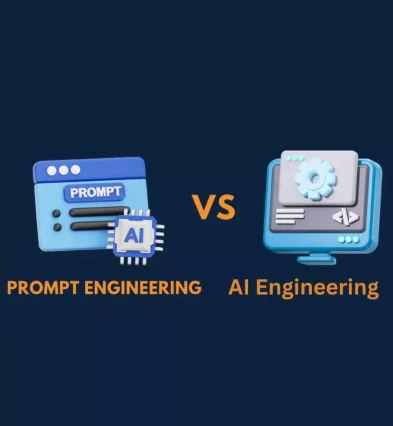
Prompt engineering focuses on crafting precise inputs that guide AI models toward accurate, useful, and context-aware outputs across tasks.
1
AI engineering involves designing, deploying, and scaling systems that integrate models into real-world applications and production environments.
2
Prompt engineers often work on content, workflows, and productivity tools, while AI engineers build infrastructure and intelligent systems.
3
Udemy helps learners explore both tracks through hands-on projects that clarify which role aligns better with career goals.
4
Top Picks: Course Paths for Each AI Career Direction
This hands-on course teaches how to design and deploy advanced AI agents using modern frameworks like OpenAI Agents SDK, LangGraph, CrewAI, AutoGen, and n8n. Learners explore memory-enabled systems, tool use, guardrails, and multi-agent collaboration for real-world automation. It covers building workflows that combine reasoning, search, and execution, along with integrating APIs and MCP services. Students also learn to orchestrate specialized agents for research, business, and creative tasks while applying practical Python skills to build scalable, production-ready AI systems with a focus on real-world deployment.
LangChain- Agentic AI Engineering with LangChain & LangGraph
LangChain- Agentic AI Engineering with LangChain & LangGraph is a developer-focused training program designed to teach how to build production-ready AI agents using LangChain and LangGraph. It focuses on real-world agentic AI systems, including RAG pipelines, tool calling, memory systems, and multi-agent architectures. The course emphasizes practical implementation in Python, helping learners understand how modern LLM applications are designed, structured, and deployed in scalable environments using frameworks like MCP and LangSmith.
AI Engineer Core Track: LLM Engineering, RAG, QLoRA, Agents
This is a structured, hands-on AI engineering program focused on building production-ready large language model applications using modern tools and techniques. The course covers everything from transformer fundamentals to advanced concepts like Retrieval-Augmented Generation (RAG), LoRA fine-tuning, and agent-based architectures. Learners build multiple real-world AI systems, including knowledge workers, chatbots, and code optimization tools, while working with frameworks like LangChain, Hugging Face, and Gradio. It is designed for software engineers aiming to transition into AI engineering with practical deployment and scalable system design skills.
AI Engineer Core Track: LLM Engineering, RAG, QLoRA, Agents
AI Engineer Core Track: LLM Engineering, RAG, QLoRA, Agents is a hands-on program designed to build real-world skills in generative AI and LLM development. It teaches how to create production-ready AI systems using RAG, fine-tuning with QLoRA, and agent-based workflows. Learners work on practical projects like AI assistants, knowledge tools, and automation systems. The course also covers frameworks such as LangChain and modern deployment practices, helping learners understand how LLMs function and how to build scalable, industry-ready AI applications from end to end.
The Complete Prompt Engineering for AI Bootcamp (2026)
A structured, hands-on training program designed to build real-world prompt engineering skills using modern AI tools like GPT-5, Midjourney, and Veo3. The course focuses on practical application through 20+ projects, covering prompt design, AI workflows, and production-ready coding patterns in Python. Learners gain exposure to advanced techniques like evaluation, retrieval, and optimization for scalable AI systems. It is aimed at beginners to intermediate learners who want to transition into AI engineering roles with job-ready, applied experience.
Prompt Engineering Certification: Master AI
A short, beginner-friendly certification course designed to turn learners into confident prompt engineers by teaching clear, structured communication with AI models like ChatGPT. It focuses on practical skills such as writing precise prompts, improving reasoning outputs, avoiding common AI mistakes, and recognizing unreliable responses. The course emphasizes real-world usage, helping users shift from casual AI interaction to intentional prompt design. With simple frameworks and examples, it is aimed at complete beginners who want to quickly understand how to get more accurate and useful results from generative AI tools.